Eatsmart Precision Plus Digital Bathroom Scale with Ultra Wide Platform and Step-on Technology, 440-Pounds
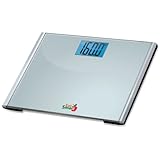
- 1) No more tapping scale to turn on. Step on and get instant readings
- 2) Large backlit 4.3" lcd display - easy to read from any distance and in any light
- 3) 4 high precision g sensors - measurement in increments .2 lbs. / 3oz. to 440 lbs or 200 kgs every time
- 4) Extra durable oversized platform - over 15 inches wide
- 5) Auto calibated; auto power-off; runs on 2 AAA batteries (included); 2 year Eatsmart guarantee
The EatSmart Precision Plus Bathroom Scale is the ideal way to track your weight loss quickly and easily. EatSmart's proprietary "Step On" technology allows you to simply step onto the scale and in seconds you'll have an accurate readout to the nearest .2 lbs on the EatSmart's oversized 4.3" LCD display. No more "waking up" your scale by tapping or pressing buttons! The LCD display also contains a cool-blue backlight, allowing for easy viewing even in the most dimly light areas of the bathroom or home. The EatSmart Precision Plus is also not only easy to use but also extremely accurate, engineered to the highest precision standards. The four high-gauge EatSmart precision G sensors ensure that you will get an accurate measurement every time. Additionally the slim, ergonomic design fits perfectly into any surroundings and oversized non-slip platform safely allows weights to 440 pounds (one of the highest capacities on the market). At over 15 inches wide this scale will fit even the big
Eatsmart Precision Plus Digital Bathroom Scale with Ultra Wide Platform and Step-on Technology, 440-Pounds
Hi,I did the following:
Scales?!??!?!?!?!?!?!?!?!?!?!?!?!?!?okay i'm going to be in a state competition and i need to know scales major and minor.... i already know my majors which are C, D, and Db (for division I )....i'm still learning Eb :( oh they have to be 3 octave...now i need to learn minor scales...which i thought were like all flats and naturals...but apperanltly they aren't...sorry for my blabbing but states is on the 28th and i need to memorize it...and i don't know what to do ;( HELP!!!!!!!!!!!!!!!!!!!!!!!!!!!
Posted by mamianka
Geez, just get a scale book, or get them from a site like www.practicespot.com Of course, for States, you need proper technique and FINGERING, and they have to be done in the correct articulations, too. How do I know? I AM A JUDGE in NY. Is seems to me like you have a TON of work ahead of you - and then there is your solo - do you also do an etude in your state? - and then sightreading.
I would assume you are a string player - no offense, but they are the easiest to get accepted, and therefore, tend to be the least prepared - or rather, I should say the woodwind and brass players need to be WAY more prepared than strings, because so FEW of them are taken, and it is a supply ans demand situation. If your teacher warned you about this, it is YOUR fault - but if your teacher FAILED TO PREPARE YOU - then it is THEM to blame. I see this all the time - yeah, they *sort of* told their students what to do, but then left them alone - and then freak out when the kids have not gotten it all done. I wish you luck - you can get this done, but it is going to COST you in time and effort - and you only have 2 weeks . . .
Posted by kindclarinetist
Hi! Take a deep breath. It will be fine.
Remember one rule: Go slower and be accurate, rather than try to play too fast. You'll sound faster if you are accurate and steady.
So, I need more information.
Do you have to learn the relative minor scales of C,D, Db and Eb or some other minor scales? Those would be a minor(relative of C), b minor (relative of D),b flat minor (Relative of Db), and g flat minor (relative of Eb).
Also, there are 3 types of minor scales. Which do you need to learn? Natural, harmonic or melodic?
Get yourself a book of scales tomorrow. Or get the scales from your band/orchestra director.
Start with the hardest one and memorize it. Memorize them really slowly in one octave first, then second octave, then third.
And next year, don't wait until two weeks before to start!!!! :)
If you answer my questions above, I'll be able to help you more.
Posted by jackie
For major:
C: no sharps or flats
G: 1 sharp
D: 2 sharps
A: 3 sharps
E: 4 sharps
B: 5 sharps
F#: 6 sharps
C#: 7 sharps
F: 1 flat
Bb: 2 flats
Eb: 3 flats
Ab: 4 flats
Db: 5 flats
Gb: 6 flats
Cb: 7 flats
So in the key of Ab major, you have four flats. How do you know what flats they are?
This is the order of flats: B, E, A, D, G, C, F
So in the key of Ab, you would have B, E, A, and D flatted.
So in the key of B major, you have five sharps. How do you know what sharps they are?
This is the order of sharps: F, C, G, D, A, E, B (the order of flats backwards)
So in the key of B you have five sharps then it would be F, C, G, D, and A all sharped.
For minor: If I tell you to find the c minor this is what you do.
You look at C major and within that scale you flat the third, the sixth, and the seventh. The third of C major is e, the sixth is a, and the seventh is b. You flat those three notes.
So C minor scale would be C, D, Eb, F, G, Ab, Bb, C
Do you see that if I were to take a key like f# minor, there would still be sharps.
Take F# major and flat the third, the sixth, and the seventh.
F# MAJOR= F#, G#, A#, B, C#, D#, E#, F#
F# MINOR= F#, G#, A (natural), B, C#, D (natural), E (natural), F#
Because A, D, and E are the the third, the sixth, and the seventh respectively.
Good luck at states...I'm sure you do great! I hope I could help.
Give your answer to this question below!
Orignal From: Eatsmart Precision Plus Digital Bathroom Scale with Ultra Wide Platform and Step-on Technology, 440-Pounds

No comments:
Post a Comment